

Web Accessibility: More Than Just Legal Compliance
How strong contrast ratios, clean document structure, and intuitive navigation make your website noticeably better for every visitor — and for search engines.
What Does Digital Accessibility Mean in Everyday Practice?
When Your Website Unintentionally Turns Visitors Away
Many corporate and medical practice websites are designed on bright studio monitors: light-gray text on a white background might look subtle in the office, yet on a smartphone outdoors or for older patients, the text becomes nearly impossible to read.
Under the European Accessibility Act (implemented in Germany as the BFSG) and the international WCAG 2.1 AA standard, a core principle takes center stage: digital services — from online appointment booking forms to e-commerce stores — must be usable by everyone without barriers.
The Four Pillars of an Accessible Website
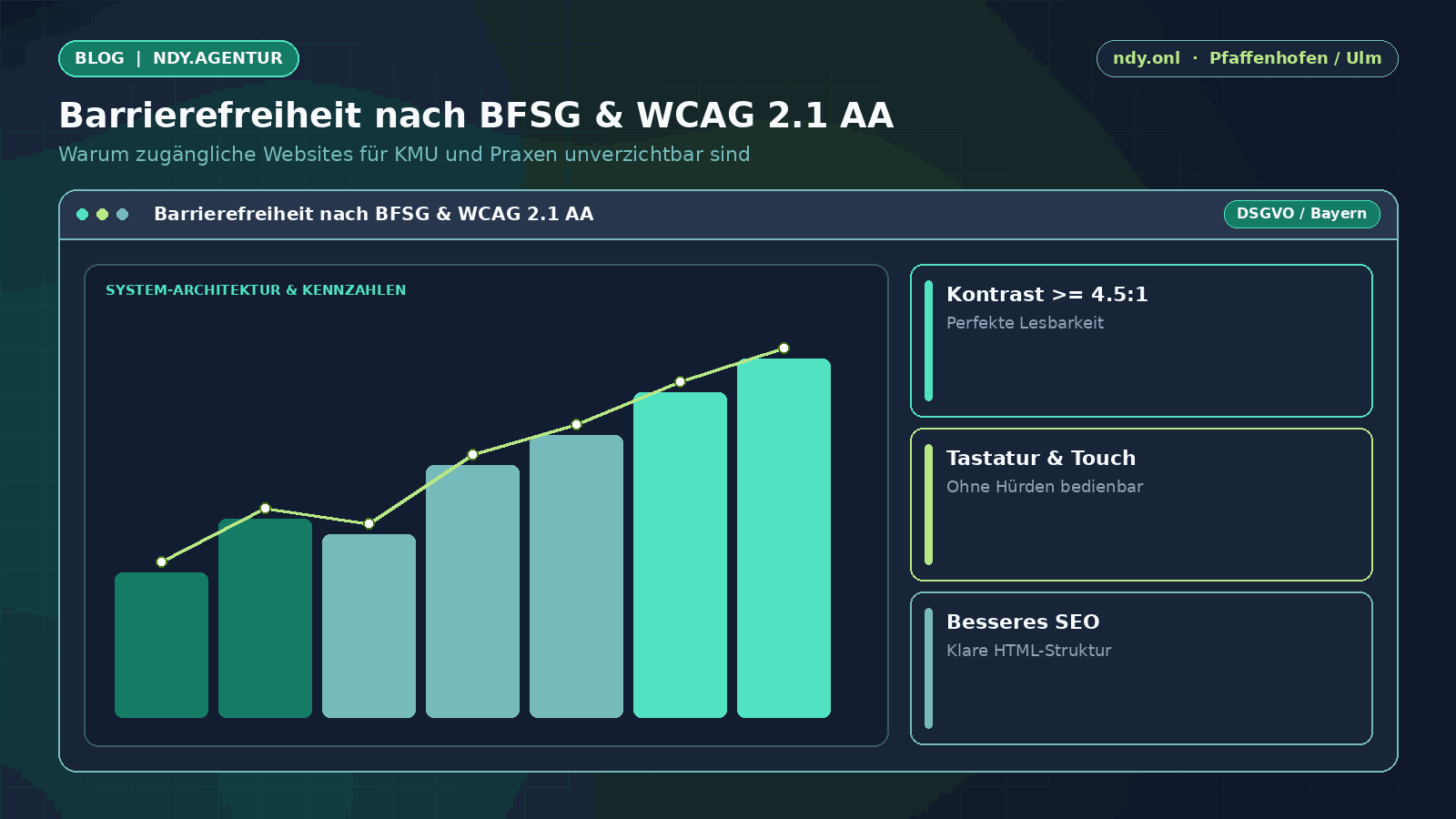
- Verified Color Contrast: Text and buttons stand out clearly against their background (at least a 4.5:1 contrast ratio).
- Clean Heading Hierarchy: A logical structure (H1 through H3) helps both screen readers and Google understand your services.
- Full Keyboard & Touch Usability: Menus, forms, and dialogs work smoothly without requiring pinpoint mouse clicks and provide generous tap targets on smartphones.
- Clear Labels & Plain Language: Every image has a meaningful description and every form input clearly communicates what is expected.
Genuine Semantic Engineering Instead of Superficial Overlay Widgets
Many vendors sell third-party "accessibility overlay widgets" that promise one-click compliance but often fail legal audits and slow down page loading.
We take the thorough approach: Our ndy.space web platform validates color contrast, semantic HTML structure, and keyboard focus directly during development — supported by our built-in WCAG Color Contrast Checker.